My Plane was purchased on the 20th of June and delivered on the 30th. These 2 pictures were taken on the 28th.
On the right they are lacing the cockpit coming to the cowl after it was painted Valspar Dutch Blue. The fellow on the left is also seen in the picture below Installing the cowling piece on a fuselage.
The originals of this whole group of pictures are now at the WACO Museum so I have hopes of one day scanning them at very high resolution to see what other secrets they hold.
Here's the same piece on my plane, just 96 years later and with me sitting in the middle. My father was 1 1/2 years old when this plane was built.
I've had the fuselage since 1996, but because of the every fragile condition of the seat and floor, I've never sat in it. I've been doing all this without even knowing if I fit in it. I decided now was the time. With the cowl piece removed I was able to support myself on the lower longerons getting in and out so I don't think I damaged anything. Once I was in we set the cowl back in place, while I worried the seat would collapse.
It's wider inside than our Fly Baby, but much less forward leg room. I should be able to fly it just fine, but it's short. It feels like Olde Tyme Flying just sitting in it. Very Cool!
Even with a cushion on the seat, I set very low. It's about like the back cockpit on John's D model WACO. Just your head is sticking out, even for my 6' 4" frame.
The windshield should give good protection without goggles.
Now I see why my granddaughter calls me Grumpa. This is my relaxed and happy face, really, I was enjoying this.
A portion of the front cockpit cowling still exists. It was used to cover up the back half of it when they cut off the fuselage to make an air boat. The big hole is for the gas gauge. The row of little holes are for the screws which attached it the the forward dash panel. I have some of the scrap which was cut off when they shortened this panel. More on it in the future.
The aft ends of the front cockpit panel and the forward ends of the aft panel are separated by about 8 inches. When you climb in or out of the front pit you support yourself directly on the upper longeron not the aluminum cowling.
In the aft cockpit the rolled edge of the opening is about 5" up from the longeron.
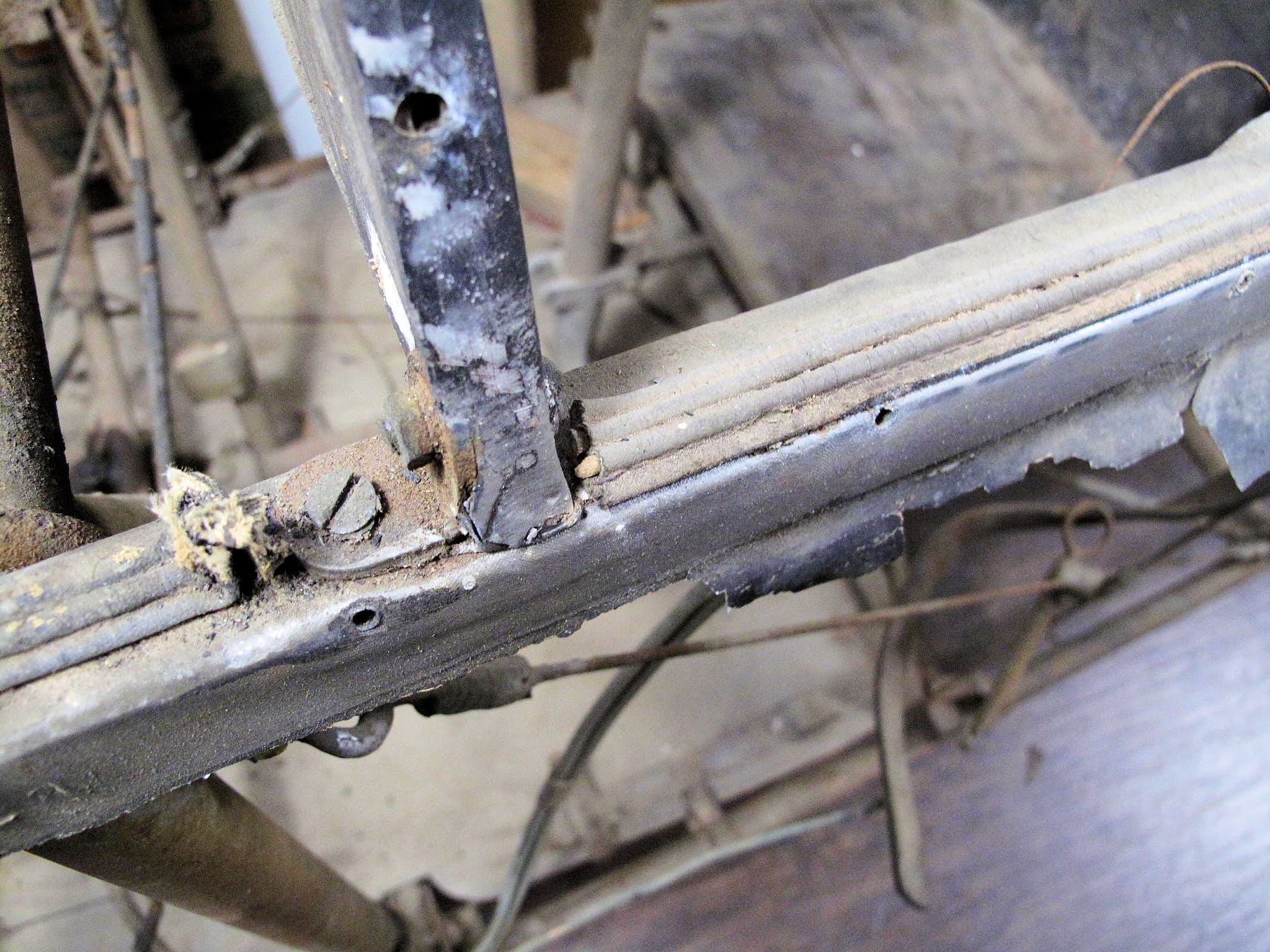
To make it stronger, so the aluminum won't bend, they added a stiffener. It's laced on at the top with the soft combing and screwed to the wood on the longeron.
There is a nice hook next to it for hanging the seat belt. I need to do that on our Fly Baby. The belt is a pain right now, always getting caught on something.
They screwed the stiffener on with #6 x 3/4" brass wood screws and brass washers, just like the whole cowl piece is screwed on (42 screws). I like the old tyme look of brass screws with the painted aluminum. Much more of a WWI era look.
The Leatherette for the cockpit coming is padded with cotton batting and laced on with wide shoe laces.
Along the top edge of the turtle deck forward former and the top of the longeron they used a strip of beaded trim. It looks like something I've seen on old buggies. It gives a nice finished edge to it. On the edge of the former it hides the end of the covering fabric, which laps over the corner.
This trim strip has 2 beads neatly sewn in a piece of leatherette.
The beads separate so you can tack it down then roll back into position hiding the tacks.
It's tacked to the wood with standard upholstery tacks. Looks like a good use for my 7th grade metal shop tack hammer.
On the longerons there is a piece of wood shaped to sit tightly on top of the tube. It's held on by wrapping it with what looks like 2" wide pinked finishing tape, then doped through to silver.
After removing a piece of the beading, in what little is left of the front cockpit, I found the remains of some "black chase leather". The sales brochure says: "The passengers' compartment... is completely lined in black chase leather." OK, it's leatherette but I'm sure it looked welcoming to anyone with a buggy or early automobile.
My objective was to get the turtle deck off so I can repair it. I plan to repair the aft cowling piece and reuse it, but first I'd like to repair the wooden turtle deck.